Showing posts with label quiet warrior racing. Show all posts

Tuesday, January 2, 2018

CA OHV Grant Workshops - Jan. 8-12 - Fiscal Support/Partnership is Force Multiplier


CA OHV Grant Supported Trail Management - Eldorado NF


QWR believes that maybe the single most important factor in modern OHV recreation is the use of diverse partnerships as a synergistic force multiplier when it comes to the management of motorized use on designated roads, trails, and riding areas.

Plumas County Sheriff - Supported with CA OHV LE Grant

Grant opportunities often act as an important fiscal support mechanism for local and federal agencies that are faced with increased demands for high quality OHV recreation while at the same time dealing with decreasing or stagnant recreation budgets.

A good example of key grant partnerships is the CA OHV Grants Program where it is hosting its annual OHV Grant Workshops next week in Northern and Southern California.

LINK TO CA OHMVR GRANT WORKSHOPS

SOUTH

Dates:   Monday, January 8, 2018
Tuesday, January 9, 2018
Where:
Bakersfield Marriott at the Convention Center
801 Truxtun Avenue
Bakersfield, CA 93301
Phone: (661) 323-1900

NORTH

Dates:   Thursday, January 11, 2018
Friday, January 12, 2018
Where:
Lions Gate Hotel
3410 Westover Street
North Highlands, CA 95652
Phone: (866) 258-5651

According to the CA OHMVR website, the Grants and Cooperative Agreements Program (Grants Program) provides for well managed off-highway vehicle recreation in the State of California by providing financial assistance to cities, counties, districts, federal agencies, state agencies, educational institutions, federally recognized Native American Tribes, and nonprofit entities.

Wetland Restoration Project - Mendocino NF

The Grants Program supports the planning, acquisition, development, maintenance, administration, operation, enforcement, restoration, and conservation of trails, trailheads, areas, and other facilities associated with the use of off-highway motor vehicles, and programs involving off-highway motor vehicle safety or education.

CA OHV Grant Funds at Work - BLM's Chappie Shasta OHV Area


QWR encourages current and potential new grant applicants to consider attending the aforementioned workshops.  There will be some important updates for grant applicants.  QWR looks forward to seeing many of the CA OHV grant participants at the workshop in Sacramento.


Monday, April 4, 2016

User/Agency Trail Field Trips Important Part of Collaborative Process

Stonyford OHV Program Manager - Sarah Ridenour-Chamberlin (R) Explains 
Soil Erosion Structures to Forest Supervisor - Ann Carlson (L), 
and Forest Recreation Officer - Katy Rich (C)

QWR is committed to the collaborative process as a strategy to bring land agency staff and the trail-based recreation community together with a common goal of both protecting resources and providing a high-quality outdoor experience.

Much of the collaborative or stakeholder process is centered on attending meetings where information is shared, values are appreciated, and relationships are formed.

QWR believes that “out-of-the office” field trips where private sector partners invite agency staff to review the development and management history of an OHV area is also an important element of the stakeholder process.

Mendocino Forest Supervisor - Ann Carlson, Reviews
St. John's Mountain Restoration Project (Funded by a CA OHV Grant)
with Agency Staff


Recently, leadership from the Mendocino National Forest toured the multiple-use recreation program on the Grindstone Ranger District.  With one of the largest destination OHV programs in the country, the District is a good case study on how OHV management prescriptions have evolved over the last 36-40 years.

Mendocino NF OHV Manager Reviews Work Order
with Trails Unlimited Crew


On the Mendocino and several other National Forests/BLM units, managed recreation didn’t start with the 2005 Travel Management Rule.   Rather, it has been a multi-decade process where the 1960s-era mining, firebreak, or logging road-based route network was gradually converted to a sustainable trail system that consists of engineered contour trails, soil loss structures, and road-to-trail conversions.

Functioning Sediment Catch Basin on System Trail

Managed federal OHV trail-based recreation programs are hard to sustain on current (and future) recreation budgets appropriated by Congress.   In some regions of the country, the Forest Service and BLM receive grants from state funding sources such as the CA OHV Division Grant Program or OR’s ATV Grant Program.

In the 21st Century, successful OHV trail programs must also rely on partnerships with the private sector such as OHV clubs, conservation groups, and other local stakeholders.   Those entities can be the source for the agency’s professional volunteer workforce where users are given chainsaw certification classes or other trail maintenance training.

Getting Ready for a Day of Trail Clearing

QWR commends those user groups and agency units where an all-hands-approach has been adopted and implemented.   QWR understands that it can take a lot of agency staff time to manage a substantive volunteer program.   However, a robust volunteer corps can also play a supportive role in helping the agency obtain non-federal resources/monies (i.e. grants to help manage their trail program, fund projects such as an OHV bridge, or donations for construction labor/materials).

Post 2012 Mill Fire Volunteer Work Party

 The collaborative process is a two-way street.  Don’t wait for agency staff to call for a meeting or workshop.  As a private sector partner, looks for ways to engage your federal contacts either at meetings, field trips, or volunteer work parties.  Be willing to do some heavy lifting yourself. 

Successful Day of Trail Clearing


QWR believes the quality of our trail future is directly proportional to the quality of the collaborative process/stakeholder involvement on your Forest or BLM unit.


Thursday, March 6, 2014

CARB Continues Outreach to OHV Community on OHMC "Red Sticker" Planning Process


QWR attended the CARB Off-Highway Motorcycle (OHMC) Workshop: Assessment Update today in Sacramento, California.

QWR wants to commend all members of the OHV community (OEMs, dealers, organizations, users, and OHMVRD) who are actively engaged in the process. 

The willingness of CARB staff to substantively engage the various stakeholders in a collaborative planning effort is ground-breaking and is a refreshing change from what some users have felt is a bunker mentality at the agency.

The key bullet points from today are:

CARB’s commitment to have a trusted observer from the OHV community at the testing events

CARB stated its effort is focused on emissions from new motorcycles, not used vehicles

CARB stated that it is not their intent to penalize or punish owners of red-sticker vehicles purchase under current laws and regulations

CARB remains committed to working with its sister agency at OHMVRD

QWR appreciated the statement by James Lombardo, legislative advocate for the California Motorcycle Dealers Association, to ask his board to help secure new motorcycles – which would be leased by CARB from the dealers – for the testing procedures.

QWR wants to urge OHV stakeholders to review the survey and related documents and submit comments on how you feel they can be modified or improved.  

Link to CARB OHMC Documents/Survey


If you have questions, please feel free to contact the CARB representative below:


Cassie Lopina
Air Pollution Specialist | California Air Resources Board | Monitoring and Laboratory Division
Evaporative Control, Engineering, and Regulatory Development Section
1900 14th Street | Sacramento, California 95811
916) 322-2411 |916) 322-2444 |

Thanks for your interest in the CARB OHMC planning process.


Monday, January 13, 2014

Recreation Fee Meeting in San Bernardino on Jan. 15-16


As the end of my term on the Region 5 Recreation Resource Advisory Committee (RRAC) approaches, I wanted to thank all of you who participated in the public process associated with the committee’s work to review fee programs and projects on Forest Service and BLM lands.

The RRAC has a public hearing scheduled for January 15 – 16, 2014 at the following location:

San Bernardino National Forest Supervisor’s Office
602 S. Tippecanoe Avenue
San Bernardino, CA
Teleconference number: 888-285-4585 Participant Code: 828106

Link to the Agenda and Proposed Fee Projects

It has been a privilege to represent summer motorized recreation on this committee.  I also want to express my thanks to the agency staff and other members of the committee for their dedication and friendship.


Even though I will be stepping down from this appointment due to term limits, rest assured that I will continue to champion responsible OHV use on public lands in other venues and support common sense user fee programs where the agency is accountable for the monies collected.  And, where those fees stay on the unit and are used for “on-the-ground” public services.


Monday, November 18, 2013

Systems Approach is Force Multiplier to OHV Management

RCD/BLM Trail Armor Project

Over the last 40 years, management of OHV recreation on public lands has evolved into a highly complex and diverse “systems approach” concept that is often at the core of successful programs.  QWR believes it is important to highlight those partnerships in order to illustrate the evolution of managed motorized trail opportunities.

Last week, QWR was privileged to do an area review of just such an effort at BLM’s Chappie-Shasta OHV Area near Redding, California.   The Western Shasta Resource Conservation District (RCD) and the Bureau of Land Management recently entered into a ten year stewardship agreement to cooperatively manage the Chappie-Shasta Off-Highway Vehicle Area.

RCD/BLM Agreement

RCD and the BLM will focus on projects related to road and trail maintenance, forest health improvement, fuel reduction, education and outreach and other efforts.  For example, trail armoring projects - as the result of this partnership - are being implemented.

This collaborative effort with the support from the Yamaha OHV Access Initiative Grant Program is also in the middle of an OHV staging area enhance project to remove invasive plants that are impacting access and use of the facility.

RCD/Yamaha OHV Access Initiative Enhancement Project

Yamaha OHV Access Initiative Grant Program

The aforementioned RCD/BLM agreement acts as a force multiplier when combined with this unit’s long-standing partnership with California’s Off-Highway Motor Vehicle Recreation Division and Commission.

CA OHV Grant Funded OHV Bridge to Protect Watershed

This is a good case study of how a comprehensive “many-hands/partners” systems approach to OHV trail and resource management is working in a synergistic manner to protect our natural environment while providing high-quality motorized trail opportunities.

# # # 


Monday, November 4, 2013

2013 Ranger Ride - Trail Management, Partnerships, and Collaboration


QWR's Don Amador Tries Out DirtBike School Course at Event

QWR believes there is no substitution for OHV-related on-the-ground training for land managers and recreation professionals.  How can a decision-maker manage an activity they don’t understand? That strong belief is why QWR teamed up with the BlueRibbon Coalition (BRC) this year to host the 2013 Ranger Ride and OHV Campout.     The event was based on a very successful series of such field conferences held during the 1990s.

OHMVRD Dep. Dir., Chris Conlin (on TTR230), Stops for Instructor

Although the shutdown prevented a number of historic event participants such as Trails Unlimited from attending, the Ride saw representatives from the Forest Service, BLM, California Conservation Corps, and the California OHV Program.   The trail workshop was held on October 29 – November 1 at the Stonyford OHV Area on the Mendocino National Forest.

DirtBike School Classroom Instruction

The event kicked off with MSF’s  DirtBike School.  Paul Hart, a certified DirtBike School coach and OHV program manager for the Shasta Trinity National Forest, taught this one-day hands-on training session to agency students from the Forest Service, BLM, California Conservation Corps, and the California Off-Highway Motor Vehicle Recreation Division (OHMVRD).  Students learned basic riding skills, trail ethics, and environmental responsibility.

DirtBike School Students Prep for Post-Graduation Trail Ride

After graduation from the course, students took part in several days of trail riding where they could polish up on their newly acquired skills.

Tahoe NF's Trail Lead, Joe Chavez, on 80 Mile Trail Ride/Review 
of OHV Management on Grindstone and Upper Lake Ranger Districts

A foundational component of these Ranger Rides is the fostering of discussion and debate related to management of OHV recreation on public lands.  Trail rides, resource tours, and campfire chats are designed to highlight important current and/or evolving management concepts. 

Mendocino NF's Forest Supervisor, Sherry Tune, Takes 1st Ever OHV Ride
Review Includes Post-Mill Fire Trail Rehab

Topics covered at this event included construction of companion trails, the value of green-sticker connector trails or mixed-use routes/corridors, new streamlined NEPA process for OHV-related watershed-based restoration projects, traditional rolling dips vs. new “tabletop” erosion control structures, hand maintained single-track trails vs. machine groomed routes,  the need to train dozer operators in the proper construction of rolling dips, creation/management of SxS-oriented routes, collaboration between stakeholders, volunteer programs, post-fire road and trail repairs/management, and many other subjects.

California Conservation Corps Review of Trail Management Structures

QWR wants to commend Region 5 for sending their trails coordinator out to the event to show support for these types of field workshops.   The Forest Supervisor for the Mendocino National Forest also attended and took her 1st ride in an OHV.  Leadership and key personnel from other units including the Shasta Trinity National Forest, California Conservation Corps, Tahoe National Forest, BLM’s Redding Field Office, and OHMVRD were there as well.  

QWR and our Sound Trails Initiative want to thank our partners and sponsors for their ongoing generous support of our efforts to champion responsible OHV recreation on public lands.  We could not do this without your help.  QWR also wants to thank RK/Excel for their support at this event for the public land volunteers who donate their personal time to help maintain our trail systems.


Stay tuned for updates as plans are already in the works for the 2014 Ranger Ride and OHV Campout.

Wednesday, September 25, 2013

Post Fire Travel Management Tools - Trail Delineators

Mill Fire's Landscape Alteration
 
Post-fire rehabilitation of destination OHV areas on Forest Service lands requires a lot dedication, determination, and dollars/labor.  Sometimes, the landscape is altered for several generations.
Key trail entrance landmarks such as trees and boulders are often destroyed by the wildfire or impacted by heavy equipment used to blaze dozer lines around the fire.
Dozer Lines Can Also Remove Trail Entrance Features
 
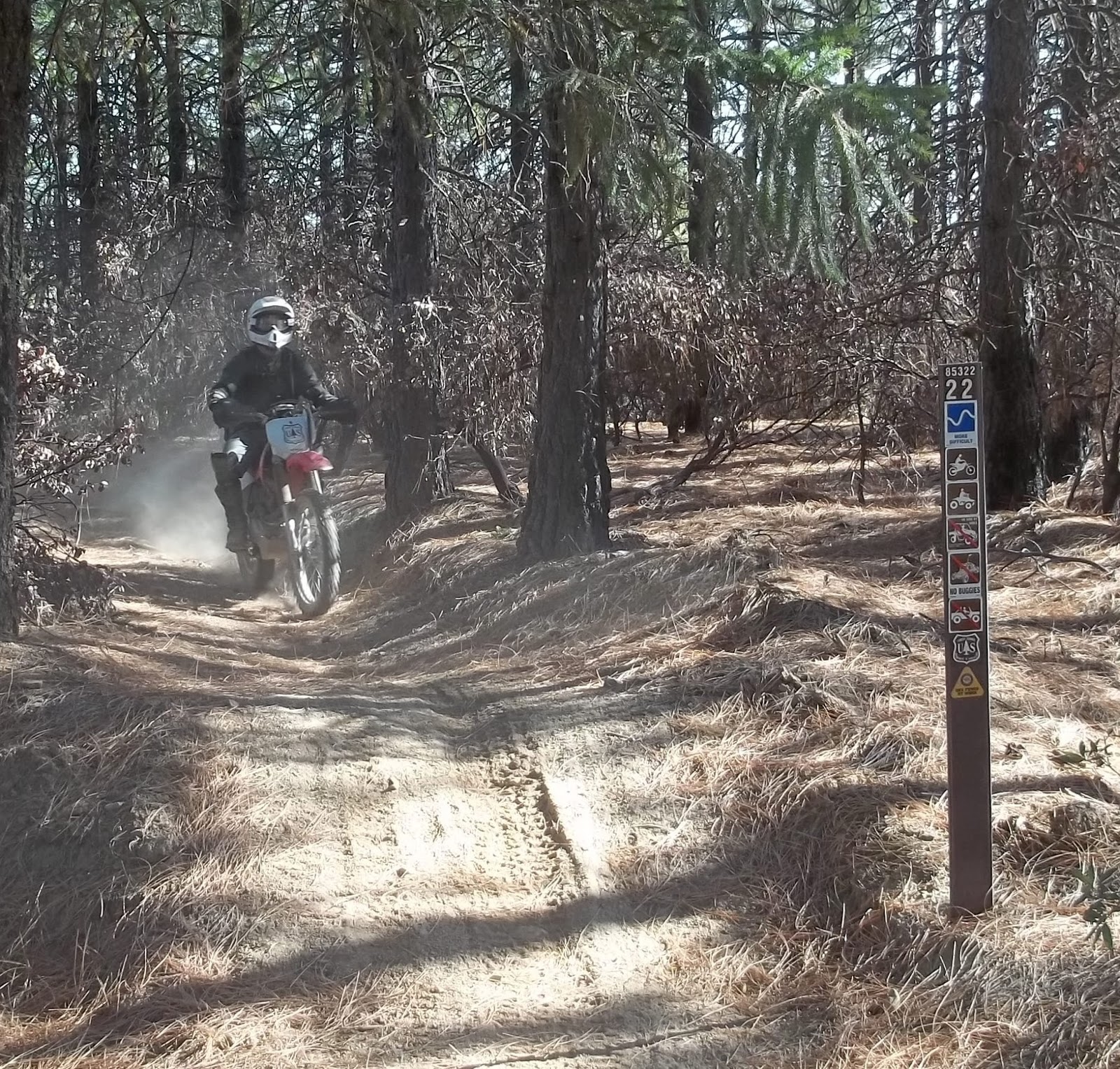
On a recent work detail, QWR’s Sound Trails Initiative had the opportunity to help restore trail entrance features and vehicle-type control devices on the Mendocino National Forest.
Trail Delineators Ready for Installation on MC/ATV Trail
 
As many of you know, the 2012 Mill Fire destroyed about 82,000 acres within the boundaries of the Stonyford OHV Area on the Grindstone Ranger District in Northern California.  Much of the landscape is now unrecognizable and important trail entrance features are no longer there.
Delineators Installed on Designated MC/ATV Trail
 
To help identify trail entrances and vehicle-type restrictions, the Forest has been installing new trail delineators on important route entrances.  Over the last year, hundreds of trail delineators have been installed with the help of agency staff and volunteers to help prepare the unit for the fall riding season.
Trail Delineators Installed on Trail for Full-Size Vehicles
 
This summer’s fire season has devastated a lot of federal timber lands in the West including portions of the Stanislaus National Forest burned by Rim Fire.  Installing managed OHV recreation trail control structures will be important to reopen those routes in an expeditious manner.
QWR believes that volunteers will continue to play an important role in those trail projects.   It is a team effort to repair post-fire damage and will require continued partnerships with users, agency staff, grant funds where available, and other stakeholders.
Agency/Volunteer Work Party
 
Lastly, QWR wants to thank our partners and sponsors for the support over the last year which has enabled us to help with the ongoing post-fire trail rehabilitation efforts on the Mendocino National Forest.
Tools of the Trade


Monday, September 16, 2013

Trails are Important Part of Life's Journey - Kyburz Interpretive Center

Kiosk at Kyburz Flat Interpretive Center
 
At QWR we believe “The Trails You Take on Life’s Journey are Important.”   Trails and forest roads can offer adventure riders a link to our past via interpretive centers often found along both well-traveled and less-traveled routes.
Station One: Kyburz Petroglyph
While participating in the 2013 Reno 200 Dual Sport Ride this past weekend,  I stopped at the Kyburz Interpretive Center to learn about what took place in this remote valley over the last 2,000 years.  This center is located on the Tahoe National Forest’s Sierraville Ranger District.
 
According to information at the kiosk, the valley was inhabited as early as 2,000 years ago by ancestors of the Washoe Indians who lived and hunted in the area.  At one of the three interpretive sites, there are rocks that contain cupules which are a form of petroglyphs.  Cupules are round pits that were etched into the rocks and are believed to be associated with various Native American rituals.  This site remains important to the Washoe Tribe.
Link to GPS Coordinates for Kyburz Flat Interpretive Center
In the 1850s, emigrants began to travel through this area.  Henness Pass Road had a stagecoach stop in the 1860s at this site and the route also provided access to this valley for grazing and timber. Basques also ran sheep in this area starting in the early 1900s. 
                                                             View of Kyburz Valley
 
Next time you are in this part of the Sierra Nevada Mountains just north of Truckee, California, take time to enjoy this information center and reflect on the many treasures that are part of our collective history.
# # #


Friday, September 13, 2013

"Sound" Advice DS Trail Tip - Two Mirror Law in Nevada


As QWR prepares to attend the 2013 Ride Reno 200 Dual Sport and Adventure Ride to operate our OHV sound education booth, we want to remind riders that two mirrors are required when you are operating a motorcycle on roads in the State of Nevada.
 

Link to 2013 Ride Reno 200
http://www.dustdevilsmc.com/Participant/ParticipantFlyer.aspx
 

According to NRS 486.311  (Mirrors) -  Every motorcycle or moped shall be equipped with two mirrors, each containing a reflection surface not less than 3 inches in diameter, with one mirror mounted on each handlebar, in positions enabling the driver to view clearly the highway for a distance of 200 feet to the rear.
 

QWR is providing this reminder so that riders coming from “one-mirror” states such as California can comply with the law and reduce the risk of being pulled over by a law enforcement officer.
 

Our good friends at the AMA have a handy website that contains current motorcycle-related laws for all 50 states.
 

AMA Motorcycle Laws
http://www.americanmotorcyclist.com/Rights/State-Laws
 

If you are coming up to the ride, be sure and stop by the sound station and say hi.


Wednesday, August 21, 2013

OHV Amateur Events are Foundational Aspect of Motorized Recreation


EDITORIAL
By Don Amador
August 21, 2013


*Permission to reprint or publish is hereby granted
 

I believe that OHV club events are culturally significant and are a foundational component of motorized recreation.  Amateur events such enduros, poker-runs, and dual-sport rides have become an important part of the recreational opportunity spectrum on state and federal lands.  They strengthen the family, create a sense of stewardship, and provide an economic benefit to the local community.
 

Amateur events are where the entire family usually attends to participate and/or support that relative who has signed up to ride.  Vacations are often planned to coincide with the event.  Vehicle and equipment preparation is where many valuable lessons are handed down from parent to child.
 

Long standing events such as the Oakland Motorcycle Club’s Jackhammer Enduro have taken place on Forest Service lands for over 40 years.  I believe these club “legacy events” creates generational ownership, pride, and stewardship of affected public lands.
 

Amateur events can also stimulate the local economy as riders patronize area restaurants, grocery stores, hotels, and gas stations.

 
In California, amateur event participants contribute directly to the Off-Highway Motor Vehicle Recreation Division’s grant program via their vehicle registration fees and fuel taxes.  Those trust funds are then used to support public land-related trail maintenance, law enforcement, environmental restoration, and safety.

 
I believe that public land agencies should be encouraging club events as a way to strengthen partnerships, support family togetherness, stimulate volunteerism at the club level, and to provide an economic benefit to the local community.   


# # #
 
Don Amador writes on environmental and land-use issues from his office in Oakley, CA. He may be reached via email at: damador@quietwarriorracing.com


Monday, July 29, 2013

California North Coast Adventure Ride Report

QWR's Don Amador at Intersection of Bald Mountain Road
and Snow Camp Road
 
The coastal mountain range in the Eureka, California area offers the dual-sport or adventure rider a lot of high-quality backcountry experiences.  While on a recent 190 mile dual-sport trip with local off-roaders to review travel management issues on the Six Rivers National Forest, l had the privilege to enjoy many of the historic non-paved and paved road segments that circle north from Eureka and out through the old logging towns of Blue Lake and Korbel, south through sections of the Forest, and back west to Eureka via Highway 36 and the Kneeland Road.

Bald Mountain Road and Snow Camp Road Intersection GPS


East Intersection of Chism Road and Hwy. 299


Leaving Korbel we took Bald Mountain Road east and turned left on Snow Camp Road to Lord Ellis Summit where we hit Highway 299.  After following Highway 299 east for a few miles, we turned left on Chism Road and stayed on that route until it joined up once again with Highway 299.  A short jaunt east on that highway took us to the top of Berry Summit where we turned right on Titlow Road. 
 
Forest Highway One
 
Route One GPS
 
After lunch at the world famous Burger Bar (located in a circa 1960s-era travel trailer) in Mad River, we headed west on Highway 36 where we gassed up at Dinsmore.  After gas, our journey took us west to Bridgeville (I think the entire town is still for sale!) where a right turn placed us on the Kneeland Road which is the mostly non-paved back entrance to Eureka.
 
Bridge at Yager Creek
 
We stopped at Yager Creek for a break and saw some pretty large trout in the steam below the bridge.  Not too far north of the bridge was the Iagua Ranch where supposedly some scenes were shot in a recent sci-fi movie.
Road Through Iagua Ranch
 
Many of you have journeyed on these routes before, but I wanted to share this info with the growing number of new riders who have joined the dual-sport/adventure family.  There are plenty of great hotels or campgrounds to stage from in the Eureka area.  The town also has a lot of cool places to visit including the Carson Mansion, Fort Humboldt, and the Samoa Cookhouse.
 
Carson Mansion
 
Be sure and stop by the Six Rivers National Forest HQ in Eureka and get one of their Forest Maps as there are lots of  two-track dirt roads to explore off of Route One.
 
# # #


Tuesday, July 9, 2013

QWR Trail Tip for CA - Purchasing a Dual-Sport Motorcycle in 2013


QWR's Factory Plated 500 EXC Dual-Sport
 
QWR has been getting a number of questions from riders in California asking about the purchase of a dual-sport motorcycle or doing a dual-sport conversion on a “Green-Sticker” off-highway motorcycle.
 
In the late 1990s, the California Air Resources Board (CARB) determined that it was illegal to register off-highway motorcycles for street use unless they were CARB or EPA certified for highway use.   QWR believes that decision was based on an ever changing regulatory climate that has become a foundation block of this state.
 
Today, the dual-sport enthusiast has only two legal options in the State of California.  One, they can purchase a street-legal dual-sport that came from the factory as such.  Or, they can purchase a used “Green-Sticker” off-highway motorcycle that was purchased new by December 31, 2003 and where the owner had initiated its dual-sport conversion with the DMV no later than January 31, 2004.
The 1st Land-Use Battle Bike - a 1995 Honda XR600 that was
Plated BEFORE the DMV Deadline
 
QWR believes that travel management and other land-use restrictions has increased the demand for street-legal dual-sport motorcycles so that riders can connect various trail networks that are separated by paved roads where non-street legal motorcycles are prohibited.
 
Based on that demand, the Industry has responded with a wide variety of factory plated dual-sport motorcycles.  QWR urges riders who are getting into the dual-sport market to do their research and find that new or used dual-sport motorcycle that both meets their need and complies with California law.
# # #

Wednesday, June 12, 2013

OHV Restoration Project Targets Trail Shortcuts


Shortcuts don’t have any redeeming value whether you are at work or on the trail.  While on a recent tour of various travel management prescriptions on the Mendocino National Forest, I had the opportunity to gauge the effectiveness and success of the St. John Mountain Restoration Project.


In 2007, the Forest applied for a restoration grant to the California Off-Highway Motor Vehicle Recreation Division’s grant program to address trail shortcuts created when the unit had an “Open” to cross country travel designation.


The agency was awarded the grant that helped support the effort to use natural woody debris and trail barriers to rehabilitate steep routes that could have impacted water quality or affected other environmental concerns.  Signs were also part of that equation.
 
As you can see in the photographs, the project has been very successful in meeting its goal to protect natural resources.  This project also had a positive benefit in that it enhances the long-term future of managed OHV recreation in the area.


QWR believes that OHV-related restoration projects have become an important tenet of managed OHV recreation in the 21st Century.  “Restoration” (R) can now be added as another foundation block to the three “E”s - Education, Enforcement, and Engineering as core elements of any successful motorized program.
# # #


Wednesday, May 22, 2013

Trail Tip - Be a Force Multiplier


As many OHV enthusiasts head out to their favorite riding areas during the late spring and early summer, QWR wants to encourage them to become an extra pair of eyes for the land management agencies.


During the winter, trees often fall down across OHV trails forcing the casual rider to either turn around or try and bypass the obstacle using an impromptu reroute.  While OHV recreational staff works hard to keep up with the trail maintenance needs of their unit, they can’t be everywhere at once.  This is where a trail rider can help by making a mental note of where the downed tree is and report it to the agency.


Be sure and include the trail or route number of where the downed vegetation is located.  This type of user involvement is greatly appreciated by the agency.  Once notified by you, they can send the appropriate staff or trail volunteer to remove the obstacle.

With ever shrinking trail budgets, this type of public service can be a force multiplier and will help keep riding areas open. 

# # #